
The interim government’s ban on Bangladesh’s largest political party undermines democracy, empowers extremists, and threatens…
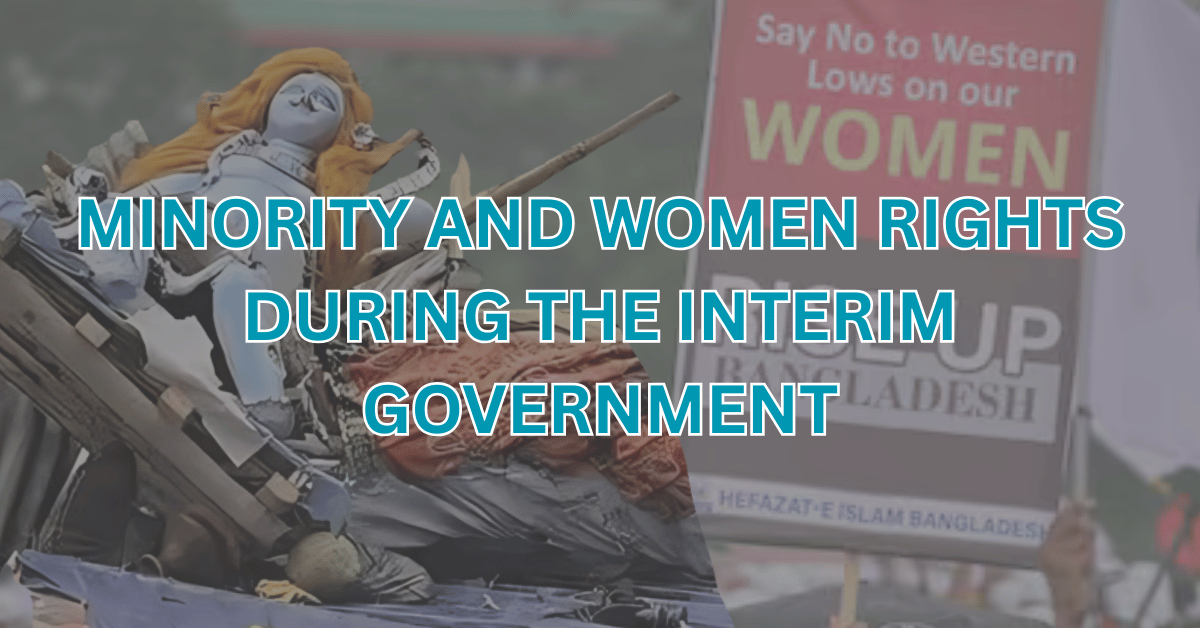
Minority and Women Rights during the Interim government
Introduction
More than one year on, the initial euphoria of the 2024 Gen-Z students’ apparent vision for a more equitable and just society has given way to a palpable sense of anxiety, particularly among religious minorities and women. The movement was hijacked by the Islamist and vested interest groups who vandalized all established institutions that represent the symbol and spirit of the liberation war. Despite the movement’s lofty goals, there is a growing perception that the country is losing its secular fabric, and the human rights situation for vulnerable groups has not seen the transformative improvement many had hoped for. This paper argues that the failure to institutionalize the gains of the 2024 movement has led to a continuation, and in some cases an exacerbation, of the very discriminations the protesters sought to eliminate, resulting in a crisis of confidence that is driving skilled minority citizens to emigrate.
Understanding the Gap between Aspiration and Reality
The trajectory of the 2024 movement can be analyzed through several sociological and political theories. According to Social Movement Theory, the Gen-Z movement fits the model of a “new social movement,” focused on issues of identity, democracy, and quality of life rather than traditional class-based economic conflicts. Its decentralized, leaderless structure, powered by social media, was a source of strength during the protests but became a weakness in the post-movement phase. The lack of formal leadership or a political party to translate demands into policy left a political vacuum, allowing traditional power structures to reassert themselves.[1]
According to the Concept of “Majoritarian Ethnic Democracy,” states maintain a democratic framework for the majority group while systematically marginalizing minorities. Despite its secular founding principles, Bangladesh has shown tendencies toward majoritarian nationalism, where the identity and interests of the Muslim-Bengali majority are often privileged in state policy and public discourse.[2] The 2024 movement challenged this but did not dismantle the underlying institutional and ideological structures. Instead, the rightists and Jamat have had it momentum to get political power and impose the Sharia-based law in the country, which will undermine the aspirations of the minority and progressive women in the country.
The Plight of Minorities: A Legacy of Insecurity Persists
The promise of “The Country for All” rings hollow for many in the Hindu, Buddhist, Christian, and indigenous communities, who continue to face persecution in many parts of the country. Bangladesh Awami League holds its political philosophy of political pluralism and secularism. However, after the ousting of Sheikh Hasina, the interim government has provided every scope to the fanatic groups to cart mobs and vandalize the places of sufies, peer and other progressive people in the country. Meenakshi Ganguly, deputy Asia director at Human Rights Watch mentions. “The interim government appears stuck, juggling an unreformed security sector, sometimes violent religious hardliners, and political groups that seem more focused on extracting vengeance on Hasina’s supporters than protecting Bangladeshis’ rights.”[3] Indeed, thousands of incidents against the minorities and women have been directed that has eroded the spirit of liberation and secular society. Key Incidents and Trends (Post-2024) can be presented as follow:
Communal Violence:
During this interim government period, Bangladesh witnessed a disturbing rise in attacks on religious minorities. Rights groups and local media documented widespread incidents of vandalism, arson, and physical assaults targeting Hindu, Buddhist, and Christian communities across the country. The Bangladesh Hindu Buddhist Christian Unity Council reported 2,442 incidents of attacks on minorities between August 2024 and June 2025, including killings, sexual assaults, temple demolitions, and destruction of homes.[4] In the first few weeks after the interim government was formed, at least 205 separate incidents were recorded across 52 districts.[5] However, Bangladeshi police claimed that of 1,415 verified complaints, roughly 1,234 were politically motivated rather than purely communal, and only 20 cases were confirmed as explicitly communal attacks.[6] This discrepancy highlights the difficulty of distinguishing between political retaliation and religious hatred in a highly polarized context. The following are the incidents directed against the minority people during this interim government:
- Minority-owned houses and temples were attacked and looted in several districts, with Hindu families reporting forced displacement.
- In Narayanganj and Chattogram, mobs set fire to shops and desecrated religious sites, prompting emergency deployments of security forces.
- Social media played a role in spreading rumors and inflammatory content that fueled panic and violence.
While large-scale pogroms have decreased, incidents of temple vandalism, land grabbing of minority-owned properties, and intimidation during religious festivals continue to be reported by organizations like Ain o Salish Kendra (ASK) and Odhikar. On July 26 and 27, a mob damaged at least 14 homes belonging to members of the Hindu minority in Rangpur district, and there are continuing violations against minority communities in the Chittagong Hill Tracts.[7] Another report says, Following Hasina’s resignation, rioters attacked her supporters, including Hindus, Ahmadi Muslims, and ethnic minorities, resulting in violence that killed over 200 people. Criminals and opposition supporters attacked shops, homes and places of worship. Many Muslims protected minorities and criticized the attacks.[8] The Hindu report that 258 communal attacks in Bangladesh in the first half of 2025 which is seriously alarming.[9] Civil society groups like the Bangladesh Hindu Buddhist Christian Unity Council (BHBCUC) have claimed that attacks against religious minorities in Bangladesh have continued under the interim government.
Targeting the Hindu Community
The Hindu community, in particular, continues to describe targeted violence and fear since the July 2024 protests. In November 2024, an estimated 30,000 Hindus protested in Chattogram, calling for the interim government to offer protection from attacks and harassment. Protestors additionally urged the government to drop sedition charges against 19 Hindu leaders, whom authorities accused of disrespecting the Bangladeshi flag during a previous protest in October. Among those accused is Hindu priest Krishna Das Prabhu, also known as Chinmoy Das, who was arrested in November 2024 and denied bail in January 2025, leading to renewed protests and clashes that resulted in the death of a Muslim lawyer. Following the killing of the Muslim lawyer, reported incidents of intimidation and attacks in Hindu neighborhoods increased. In May 2025, the Supreme Court granted a stay on a High Court order granting Das bail. Some notable incidents against the Hindu communities are as follow:[10]
- According to BHBCUC in the first three months of 2025, a total of 92 incidents took place targeting religious minorities. This includes 11 murders, three rapes, 25 attacks on temples, and 28 instances of vandalism.
- Ain o Salish Kendra (ASK), a Bangladeshi human rights organization, reported a total of 48 attacks against religious minorities from January to April 2025, including 25 attacks against Hindu statues.
- Hindu women have stopped wearing bangles and bindis to avoid being harassed. Bangladeshi media sources also continue to report some instances of violence, vandalism, and harassment against religious minorities.
Digital Vigilantism and Hate Speech:
Social media platforms are increasingly used to target religious minorities with hate speech and false accusations of blasphemy, often leading to real-world violence and police complaints under the Digital Security Act. After the July 2024 protests, misinformation and disinformation saturated the news environment, particularly related to attacks against religious minority communities, which have created a climate of fear. Such disinformation falsely claimed that certain Hindu temples were attacked, circulating fabricated videos of arson or Hindu women being attacked. Human rights organizations similarly say that social media and misinformation continue to contribute to attacks against religious minorities. Additionally, journalists in Bangladesh reporting on religious freedom issues expressed concerns about harassment from mobs and more conservative Islamic groups. In November 2024, for example, a mob accused news sources like the Daily Star of promoting ideals they considered “contrary to Islam,” including secularism and women’s rights. The attackers demanded that these newspapers be closed if they did not apologize for their “anti-Islamic positions.”[11]
Systemic Disenfranchisement:
Discriminatory laws and practices, such as the Vested Property Act (a continuation of the earlier Enemy Property Act), continue to be used to dispossess Hindu families of their land, undermining their economic security and sense of belonging. Between August 6 and September 25, 2024, police lodged cases against 92,486 people, most of them related to murder. Nearly 400 former ministers, members of parliament, and other Awami League officials have been named in over 1,170 cases, which also include hundreds of unnamed individuals.[12] The report by RRAG identified serious violations, noting that more than 272,000 individuals—primarily political opponent —have been implicated in 1,598 criminal cases within the first 100 days of Yunus’ administration. The organization reported that between September 19 and October 1, at least four Indigenous people were killed, and more than 75 others were injured.[13] Leaders of the Bangladesh Hindu Buddhist Christian Unity Counci claims that 2,010 incidents of communal violence took place across the Muslim-majority country between Aug. 4 and 20, 2025. The Yunus-led government disputed the claim, saying that most of the incidents were caused by “political reasons” and not by communal issues. However, different sources confirmed that most of the cases were directed against the minority and opposing political people.
The Status of Women and girls: Progress and Peril
The Gen-Z movement was notably inclusive of young women, who were at the forefront of the protests. However, the broader landscape for women’s rights remains complex and troubling. Bangladesh is currently facing a grave escalation in gender-based violence, marked by a surge in rape and sexual assault cases. This trend has intensified under the administration of the constitutionally illegitimate interim government, where legal accountability has weakened, and institutional safeguards have deteriorated significantly. Bangladesh grapples with shocking surge in sexual violence:[14]
- According to verified media reports, from January to June 2025, a total of 481 cases of rape were reported nationwide. Among these:
- 345 victims were children, highlighting a disproportionate targeting of minors
- 106 cases involved gang rape, indicating the organized and aggravated nature of many assaults.
- 17 victims were murdered following the assault, illustrating a pattern of extreme brutality and intent to eliminate evidence or silence survivors.
- 1,555 women and girls were reported to have experienced violence in the first half of the year alone, encompassing both physical and sexual abuse.
The Human Rights Congress for Bangladesh Minorities (HRCBM) mentioned that Bangladesh is facing an alarming wave of sexual violence, particularly targeting women and children from minority communities like Hindus, Christians, Buddhists and others. According to the Rights Body, the violence has reached pandemic proportions under the Muhammad Yunus-led interim government. HRCBM noted that “342 rape cases were officially recorded in less than three months during the first quarter of 2025, with 87 per cent of the victims being girls under 18 years of age”.[15] According to the rights body, these horrifying figures represent only the tip of the iceberg, and the true number runs into thousands, which is hidden by silence, fear, and state inaction. The following table shows the scenario of women rights violation during this interim period.
Violence against Women and Girls in Bangladesh: Key Statistics (2024 – Mid-2025)
| Category / Period | Key Statistics | Specific Details & Breakdown | Source / Reference |
| March 2025 (General Violence) | 442 women & girls faced violence. | • 125 girls and 38 women were raped. • 36 were gang-raped (including 18 girls). • 2 girls were raped and murdered. • 55 girls and 15 women survived attempted rape. | Human Rights Organizations’ Compilation |
| First Half of 2025 (Trend) | Sharp increase in reported cases. | • Jan-Apr 2024: 5,795 cases. • Jan-Apr 2025: 7,028 cases. | Bangladesh Police Records |
| Full Year 2024 (Rape) | 558 total rape victims. | • 284 victims (approx. 51%) were minors. • 130 victims were gang-raped. • 40 victims were killed after rape (including children). | Human Rights Society of Bangladesh (hrssbd.org) |
| Jan-Oct 2024 (General Violence) | 2,197 women & girls subjected to violence. | • Included 830 rape incidents nationwide. • 39 women were killed after rape. • 7 victims died by suicide as a result. | Human Rights Organizations’ Compilation |
| 2024 (Bangladesh Mahila Parishad Survey) | 364 rape cases analyzed. | • 220 victims (majority) were minors. • Gang rape victims: 49 minors & 99 adults. | Prothom Alo |
| October 2024 (Monthly Snapshot) | Over 200 women & girls were tortured. | • 44 rape cases (including 14 minor girls). • 4 dowry-related murders. • 4 incidents of child marriage. | Dhaka Tribune |
Political Participation vs. Social Reality
While Bangladesh has had a female head of state for decades, this has not trickled down to empower most women at the grassroots level. In addition, over 8,600 people were reportedly arrested in a crackdown in February called “Operation Devil Hunt,” many of them allegedly Awami League supporters.[16] BBC news reports that ‘There is no law and order. And Hindus are being targeted again”.[17] The religious minority people hardly get any scope to participate in any procession and inform their conditions to the authority. The media is also controlled by the Islamist groups that hinder presenting the information of minority repression.
The Burden of Digital Laws
The Digital Security Act (DSA), despite its intended purpose, has been used to harass and imprison women who speak out online against harassment or injustice, creating a chilling effect on freedom of expression (Amnesty International, 2024).
Table 2: Selected Indicators on Women’s Security (Based on Secondary Data)
| Indicator | Pre-2024 Trend | Post-2024 Observation (Initial 12 Months) | Source |
| Reported Rape Cases | Consistently high (~1,000+ per year) | High in increase before the previous regime | ASK, 2024 Annual Report |
| Use of DSA against Women | Increasing | Continued use to silence female activists and victims | Amnesty International, 2024 |
| Women in High-Level Govt. Posts | Stable but limited | The condition is deteriorating, not improving as promised. | Bangladesh Bureau of Statistics |
| Economic Participation Rate | Slowly increasing | Structural barriers remain and increasing | World Bank, 2025 |
Position of Women and Minorities in Government Position
Based on recent reports and surveys, it is evident that both women and minority groups in Bangladesh have been systematically marginalized in political participation and social protection under the current interim arrangements. For example, in six major reform commissions formed between 2024–2025, out of fifty total members, only five were women, representing merely around 10 percent participation, and no members were drawn from religious or ethnic minority communities. This exclusion highlights how decision-making spaces remain dominated by male and majority voices, with women and minorities sidelined from shaping key reforms. Although the Women’s Reform Commission proposed progressive measures such as expanding parliament to 600 seats with directly elected reserved constituencies for women and ensuring that each political party nominates at least 7 percent female candidates in general seats, the structural underrepresentation persists. The situation of minorities has been even more concerning in terms of security. According to the Bangladesh Hindu Buddhist Christian Unity Council, from August 4 to August 20, 2024, there were over 2,010 incidents of communal violence, followed by 174 more incidents between late August and December, which included 23 deaths, sexual assaults, arson, and widespread vandalism. Despite these alarming figures, a VOA survey found that while 64.1 percent of respondents believed the interim government provided better protection to minorities compared to previous administrations, 33.9 percent of minority respondents felt that their safety had actually deteriorated. This paradox underscores both the heightened vulnerability of minorities and the uneven perception of security improvements.
Together, these statistics illustrate how women continue to be underrepresented in formal political structures while minorities remain vulnerable to violence and exclusion, leaving both groups cornered in a fragile socio-political landscape. Moreover, the government systematically ignored the women and minority political leaders while discussing political issues. The interim government vehemently emphasizes on Islamic political parties where women and minority representation is nil.
Conclusion: A Crossroads for the Nation
The 2024 Gen-Z movement was a watershed moment that revealed a deep-seated public desire for a Bangladesh that truly lives up to its founding promise of secularism and equality. The slogan “The Country for All” was a powerful articulation of this vision. But it was a device by the vested interest group to divert the attention of the mass-people who came outside and protested against the government of Hasina. Now, they have understood their mistake that it was a movement of Jamat and Shibir to fulfil their long desire of capturing political power and work for pro-Pakistani motive. During this one year of the movement much has been cleared to the people that it was not a honest movement, but was a deep conspiracy against Sheikh Hasina.
One year later, the nation stands at a crossroads. The anxiety among minorities and women, coupled with the emigration of skilled citizens, is a stark indicator that the movement’s aspirations have yet to be translated into tangible institutional and social reform. The “secular flavor” of the nation is indeed under threat, not necessarily from a single policy, but from a persistent culture of majoritarian impunity and a state apparatus that has been slow to protect its most vulnerable citizens.
For “The Country for All” to transition from a slogan to a reality, sustained political will, legal and institutional reforms to protect minority rights and women’s safety, and a conscious effort to promote a national identity based on civic rather than religious nationalism are urgently required.
[1] Tarrow, S. (2011). Power in Movement: Social Movements and Contentious Politics (3rd ed.). Cambridge University Press.
[2] Bhattacharyya, S. (2023). Majoritarianism in South Asia: A Comparative Study. SAGE Publications.
[3] Human Rights Watch. July 2025. Bangladesh: Year since Hasina Fled, Rights Challenges Abound. Retrieved: https://www.hrw.org/news/2025/07/30/bangladesh-year-since-hasina-fled-rights-challenges-abound.
[4] Times of India. (2025, February 24). Minorities under fire in Bangladesh: 2,442 hate crimes, perpetrators enjoy impunity. [https://timesofindia.indiatimes.com/world/south-asia/minorities-under-fire-in-bangladesh-2442-hate-crimes-perpetrators-enjoy impunity/articleshow/122370916.cms](https://timesofindia.indiatimes.com/world/south-asia/minorities-under-fire-in-bangladesh-2442-hate-crimes-perpetrators-enjoy-impunity/articleshow/122370916.cms).
[5] News18. (2024, August 20). Bangladesh’s interim leader Yunus urges youth to protect minorities after attacks. [https://www.news18.com/world/heinous-bangladeshs-interim-leader-yunus-condemns-attacks-on-minorities-urges-youth-to-protect-them-9012051.html](https://www.news18.com/world/heinous-bangladeshs-interim-leader-yunus-condemns-attacks-on-minorities-urges-youth-to-protect-them-9012051.html).
[6] Hindustan Times. (2024, August 31). *Majority of attacks against minorities political, only few communal: Bangladesh police*. [https://www.hindustantimes.com/india-news/majority-attacks-against-minorities-political-only-few-communal-bangladesh-police-101736613009154.html](https://www.hindustantimes.com/india-news/majority-attacks-against-minorities-political-only-few-communal-bangladesh-police-101736613009154.html)
[7] Ibid.
[8] Human Rights Watch Report 2025. See: https://www.hrw.org/world-report/2025/country-chapters/bangladesh.
[9] The Hindu. See: https://www.thehindu.com/news/international/258-communal-attacks-in-bangladesh-in-the-first-half-of-2025-bangladesh-minority-religious-group/article69797365.ece.
[10] UNITED STATES COMMISSION on INTERNATIONAL RELIGIOUS FREEDOM. Fact Sheet Bangladesh. July 2025. See: https://www.uscirf.gov/sites/default/files/2025-07/2025%20Factsheet%20Bangladesh.pdf.
[11] Ibid.
[12] Human Rights Watch. July 2025. Bangladesh: Year since Hasina Fled, Rights Challenges Abound. Retrieved: https://www.hrw.org/news/2025/07/30/bangladesh-year-since-hasina-fled-rights-challenges-abound.
[13] DW, December, 2024. Bangladesh: Are human rights eroding under Muhammad Yunus? See: https://www.dw.com/en/bangladesh-are-human-rights-eroding-under-muhammad-yunus/a-71185927.
[14] Vatican News. 2025. See: https://www.vaticannews.va/en/church/news/2024-07/1045-cases-of-violence-on-minorities-recorded-in-bangladesh.html.
[15] HRCBM: Sexual Violence Rising In Bangladesh, Targeting Minority Women And Children Crisp Headline. See: https://www.newsonair.gov.in/hrcbm-sexual-violence-rising-in-bangladesh-targeting-minority-women-and-children-crisp-headline/.
[16] Human Rights Watch. July 2025. Bangladesh: Year since Hasina Fled, Rights Challenges Abound. Retrieved: https://www.hrw.org/news/2025/07/30/bangladesh-year-since-hasina-fled-rights-challenges-abound.
[17] BBC. 7 August 2024. SEE: https://www.bbc.com/news/articles/cwy77vgmjlzo.
The authors are Professors of a Prominent University
Related Posts
Comments (0)