
The interim government’s ban on Bangladesh’s largest political party undermines democracy, empowers extremists, and threatens…
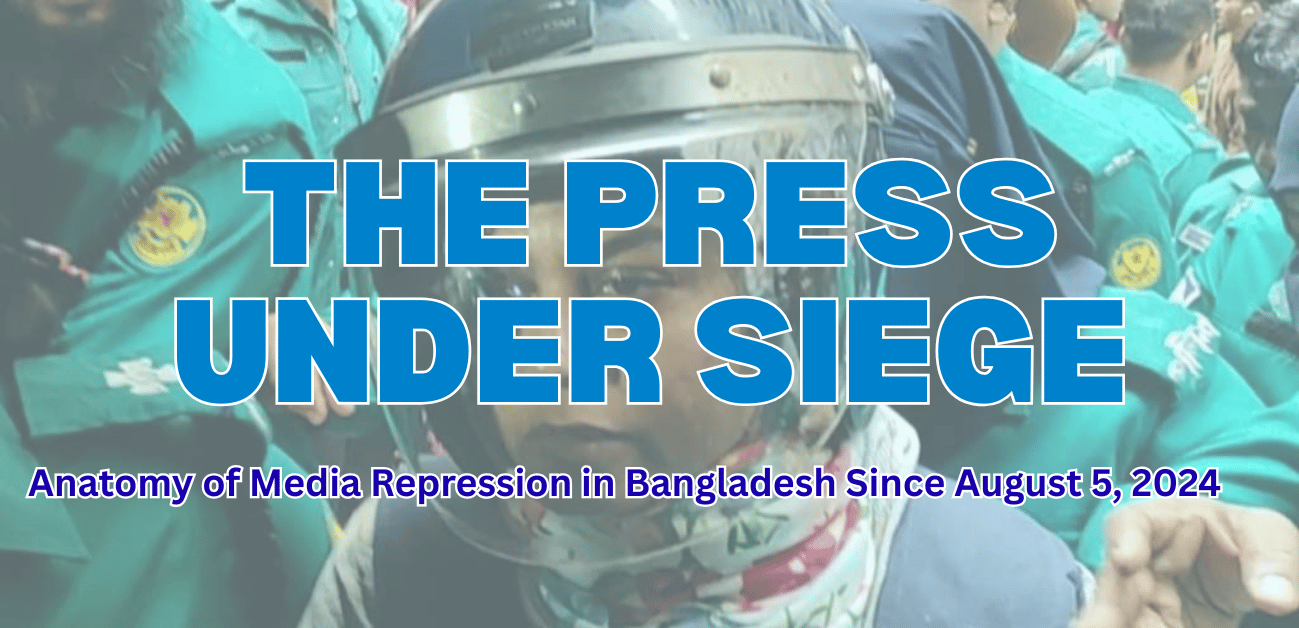
The Press Under Siege: Anatomy of Media Repression in Bangladesh Since August 5, 2024
Executive Summary
Since the fall of Sheikh Hasina’s elected government on August 5, 2024, Bangladesh’s interim regime has initiated a sweeping and unprecedented crackdown on press freedom. This report documents the systematic repression of independent journalism, the hostile takeover of media institutions, and the deployment of both legal and extrajudicial mechanisms to silence dissent and manufacture public consent. Backed by the National Citizen Party (NCP) and radical Islamist factions, the unelected regime has pursued a calculated strategy to delegitimize secular narratives and insulate its authority from scrutiny.
To date, over 388 journalists have been implicated in fabricated criminal cases—most on spurious murder charges—with at least 38 currently imprisoned and repeatedly denied bail. Vague and politically motivated allegations such as “inciting unrest” or “spreading misinformation” have become standard tools of intimidation. Media houses have faced mass firings, enforced leadership changes, and ideological cleansing through the promotion of editors and anchors aligned with the Bangladesh Nationalist Party (BNP) and Jamaat-e-Islami (JeI). The judiciary—particularly the International Crimes Tribunal (ICT)—has been weaponized to impose an unofficial blackout on any positive reporting about the Awami League (AL) or its leadership. A recent amendment to the Anti-Terrorism Act (ATA) now criminalizes news coverage related to AL activities, equating political journalism with terrorism.
Even the country’s leading dailies, such as Prothom Alo and The Daily Star, have faced intimidation tactics including mob-led sit-ins, Islamist provocations, and psychological pressure—all carried out with tacit state approval. Notably, even previously neutral outlets have not been spared, indicating a comprehensive purge of independent voices. Meanwhile, civil society remains suppressed, and international condemnation has yet to evolve into meaningful diplomatic leverage.
This report explores the ideological motivations behind the repression—including the Islamization of public discourse, erasure of Bangladesh’s secular legacy from 1971, and suppression of democratic accountability. It concludes with an urgent appeal to international actors to demand the repeal of repressive laws, the withdrawal of politically motivated cases, and the restoration of media freedom. If left unaddressed, this repression risks normalizing authoritarian rule and pushing Bangladesh further from its democratic trajectory.
I. Introduction
The political landscape of Bangladesh has undergone a profound transformation since the fall of the elected AL government on August 5, 2024. In the wake of this political upheaval, the unelected interim regime has swiftly dismantled democratic norms and consolidated authoritarian control. Central to this consolidation has been a coordinated, aggressive, and ideologically driven crackdown on press freedom, undermining one of the most essential pillars of democratic governance.
This report, The Press Under Siege, offers a detailed examination of the anatomy of media repression in Bangladesh under the interim regime. Drawing from verified legal documents, institutional data, and testimonies from journalists and media professionals, it presents a comprehensive analysis of how state machinery has been weaponized to silence independent journalism. Legal tools such as fabricated First Information Reports (FIRs), non-bailable criminal charges, and expansive anti-terror laws have been systematically deployed to harass, arrest, and detain journalists. These legal measures are complemented by extrajudicial tactics, including forced dismissals, digital surveillance, ideological purges of newsrooms, and the dismantling of editorial independence.
More disturbing is the regime’s growing alignment with radical Islamist groups. The promotion of BNP and JeI-affiliated figures into key media leadership roles, combined with the tacit endorsement of intimidation campaigns by extremist outfits such as Tawhidi Janata—a street force mobilized by Hefazat-e-Islam (HeI) and supported by proscribed groups like Ansar al-Islam (AAI) and Hizb ut-Tahrir (HuT)—reveals a dangerous convergence between authoritarian statecraft and Islamist populism. Institutions like the ICT have been co-opted to issue vague directives effectively criminalizing any favourable coverage of AL leaders, particularly Sheikh Hasina.
The domestic response has been muted, stifled by fear, surveillance, and the threat of reprisal. Meanwhile, international reactions—though critical in tone—have yet to generate the sustained pressure necessary to reverse the tide of repression. This report concludes by offering strategic recommendations for domestic actors and international stakeholders committed to democratic recovery in Bangladesh.
What follows is not merely an account of repression. It is an urgent call to confront a deepening crisis at the intersection of authoritarianism, ideological radicalization, and media capture. The future of democracy in Bangladesh may well depend on whether the freedom of the press can be reclaimed before it is extinguished entirely.
II. Mechanisms of Media Repression
Since its inception, Bangladesh’s interim regime has pursued a comprehensive, multi-pronged strategy to suppress independent journalism and dismantle press freedom. This section examines the state’s repressive mechanisms—from legal persecution and violent intimidation to institutional overhauls and ideological control. Collectively, these tactics expose a deliberate and systematic campaign to silence dissent, control public discourse, and consolidate authoritarian power.
A. Legal Harassment and Arbitrary Detention
Journalists Accused in Fabricated Cases: Since the interim government took control in August 2024, at least 388 journalists across Bangladesh have been named in fabricated cases designed to silence dissent. These charges are often filed en masse and lack substantiating evidence, typically relying on vague accusations such as “undermining national security” or “defaming state institutions.” The bulk of these cases are lodged by local leaders of the BNP, JeI, NCP, pro-Islamist actors, or state-backed vigilantes to create a chilling effect across the profession.
Arrest and Detention: At least 38 journalists, including editors, have been arrested under a wide array of politically motivated charges, primarily aimed at silencing dissent and stifling independent reporting. These arrests are often executed in the dead of night without proper warrants or legal justification. Security forces, operating with impunity, frequently detain journalists from their homes or workplaces without informing families of their whereabouts. This tactic fosters an environment of intimidation and unpredictability, sending a chilling message to the broader media community that no one is beyond the reach of state repression.
Abuse of Police Remand to Inflict Psychological Pressure: A particularly cruel tactic employed by the interim regime is the routine placement of arrested journalists under police remand, often without any substantiated charges or credible evidence. Once detained, journalists are frequently subjected to extended periods of police custody—ostensibly for interrogation, but in practice, used to inflict sustained psychological stress. These remands are not sanctioned through impartial legal processes; instead, post-August judicial appointments—heavily biased in favour of the regime—have facilitated the arbitrary granting of police custody without due hearings from defence counsels. The true intent of such remand is not investigation but intimidation—sending a clear signal that dissenting voices will be mentally broken even before trial proceedings begin.
Denial of Bail: Once in custody, detained journalists face systematic judicial harassment. Courts, under direct or indirect pressure from the regime, routinely deny bail regardless of the flimsy or fabricated nature of the charges. The use of non-bailable sections under vague laws—such as incitement, sedition, or spreading misinformation—ensures prolonged pre-trial detention. In many instances, while the journalist remains imprisoned, fresh charges are filed to keep them incarcerated indefinitely. This weaponization of the legal system has effectively turned pre-trial detention into a tool of punishment, bypassing due process and undermining the independence of the judiciary.
Notable Tactic: One of the regime’s most insidious tools is the misuse of vague legal provisions to file non-bailable charges. Laws originally intended to combat terrorism or communal violence are being repurposed to stifle journalistic work. Accusations like “inciting violence” or “spreading misinformation” are applied indiscriminately, often based on social media posts, investigative reporting, or even private communications. These charges are broad enough to criminalize almost any critical viewpoint, and are used to bypass the protections normally afforded to journalists.
B. Violence, Threats, and Intimidation
Physical Attacks: Since August 5, 2024, there has been a sharp escalation in physical violence against journalists in Bangladesh. At least 63 reporters have been assaulted by state-backed operatives, affiliates of the ruling coalition, and Islamist mobs while covering protests, reporting on political developments, or investigating regime abuses. These attacks—including beatings, public mob assaults, and attempted abductions—are often carried out in broad daylight to instill fear and deter critical reporting. Perpetrators are rarely held accountable, fostering a culture of impunity. Most alarmingly, at least eight journalists have been killed since August 2024, underscoring the lethal risks of practicing independent journalism under the interim regime.
Targeted Intimidation by Government Machinery: The Chief Advisor’s Press Wing, the Ministry of Information, and various security agencies have jointly adopted systematic tactics to intimidate, monitor, and suppress independent journalists. Intelligence operatives, often in coordination with local police, routinely engage in phone tapping, digital surveillance, and late-night visits to journalists’ homes—framed as “routine checks” or unofficial warnings. In numerous documented cases, outspoken reporters have had their residences raided without warrants under the vague pretext of searching for “anti-state materials.” These operations, carried out with impunity, are not merely punitive—they are designed to instill fear and break the collective morale of the journalistic community, discouraging critical reporting and reinforcing a culture of silence.
Threats from Extremist and Pro-NCP Groups: A disturbing number of journalists have received death threats from both Islamist extremists and pro-NCP social media networks. These threats often follow critical reporting on religious fundamentalism, the interim regime’s alliance with hardline groups, or human rights abuses. Some journalists have been “doxxed,” with personal information circulated online, prompting security concerns and forcing many to go into hiding. The government’s silence—and in some cases, covert encouragement—has emboldened these radical networks to act with increased aggression.
Forced Exile: Facing relentless persecution, over a dozen high-profile journalists have fled Bangladesh since August 2024. Most have sought asylum in Europe, North America, or neighbouring countries, citing credible threats to their lives and freedom. These include investigative reporters, TV anchors, and editors known for their secular, liberal stances. In exile, they continue to face pressure—through family intimidation back home and cyber harassment abroad—highlighting the transnational reach of the interim regime’s repression apparatus.
C. Institutional Restructuring
Mass Dismissals of Media Professionals: As part of a deliberate campaign to restructure the media landscape, the interim government has overseen the dismissal of at least 135 media professionals from prominent Dhaka-based outlets. This number excludes the widespread purging of local correspondents across the country. Simultaneously, 80 employees of the state-run Bangladesh Television (BTV)—including senior management, bureau chiefs, and veteran correspondents—have been removed from their posts. These dismissals were neither preceded by due process nor justified with professional grounds; rather, they were politically motivated purges designed to eliminate dissenting or neutral voices within the media.
Strategic Leadership Overhaul: In the wake of widespread dismissals, the interim regime has installed partisan loyalists—primarily aligned with the BNP, JeI, and the NCP—into senior editorial and executive roles across Bangladesh’s media landscape. Key officials, including the Director General of Bangladesh Sangbad Sangstha (BSS), the state-run news agency, have been removed and replaced with individuals affiliated with the BNP and JeI, regardless of their qualifications or professional experience. Similarly, at BTV and nearly all major private television networks, formerly independent or secular professionals have been purged and replaced with ideologically aligned appointees, often lacking journalistic experience or credibility. Print media has witnessed a similar transformation, with regime-friendly figures placed in key decision-making positions, reshaping editorial leadership to serve political ends.
Narrative Control and Media Co-Option: These leadership changes have enabled the regime to fully co-opt the media, turning once-diverse newsrooms into tools of state propaganda. Editorial lines now center on delegitimizing the AL, justifying the regime’s prolonged tenure, and suppressing scrutiny of military influence and Islamist resurgence. Reporting is carefully curated to exclude dissent, propagate misinformation, and reinforce a manufactured consensus. This systematic control of public and private media outlets has created an information environment where opposition voices are silenced, and the public is continuously exposed to regime-approved narratives.
D. From Courtroom to Newsroom: Legal Warfare Against the Press
Coordinated Media Suppression through ICT and Press Office: The Chief Prosecutor of the ICT, known for his partisan bias, secured a discreet ruling from ICT judges prohibiting any positive media coverage of Sheikh Hasina and other AL figures. The ruling was delivered vaguely and without transparency. Simultaneously, the Chief Advisor’s Press Wing issued unofficial instructions to major media outlets to amplify negative—mostly false or fabricated—content targeting Sheikh Hasina, her family, and senior AL leaders, reinforcing a coordinated campaign of reputational assault.
Suppressing Political Reporting via Anti-Terrorism Legislation: A recent amendment to the ATA criminalizes the publication of any news related to AL or its affiliates, branding such content as a threat to national security. This clearly equates political reporting with terrorism. The Editors’ Council has denounced the move, calling it a grave threat to press freedom and demanding its repeal. The regime, however, remains unmoved—turning the law into a tool for ideological suppression.
III. Suppression of Digital and Cultural Expression
The interim regime’s assault on freedom of expression has extended beyond traditional media into the digital and cultural spheres, where dissent is met with aggressive censorship, surveillance, and legal persecution. Online platforms, once vibrant spaces for independent journalism and civic discourse, have been systematically undermined through website blocking, algorithmic manipulation, and cyber-policing. Simultaneously, the judiciary and regulatory bodies have been weaponized to criminalize political reporting, silence critical voices, and enforce ideological conformity across both digital and legal domains.
Digital Censorship and Algorithmic Suppression
Website Blocking: In a sweeping crackdown on online dissent, the Bangladesh Telecommunication Regulatory Commission (BTRC), under directives from the interim regime, has blocked access to more than 200 news websites, blogs, and citizen journalism platforms. Most of these platforms were known for exposing regime abuses, reporting on civil-military tensions, or publishing secular and progressive commentary. The shutdowns were executed without formal explanation or legal recourse, often in the dead of night, leaving affected media unable to challenge the decisions or alert their readers.
Algorithmic Suppression: In coordination with social media monitoring units and hired foreign firms, the regime has reportedly used advanced algorithmic tools to suppress opposition voices online. Posts critical of the interim government, military overreach, or the rising influence of Islamist forces are increasingly subjected to shadow-banning, flagging, or takedown under vague community standards. Influential digital activists, journalists, and academics report declining engagement and visibility, indicating a systematic manipulation of content moderation processes in cooperation with platform providers or through backdoor lobbying.
Targeting of Journalists on Social Media: The Detective Branch (DB), Criminal Investigation Department (CID), and Rapid Action Battalion (RAB) of the Bangladesh Police have been weaponized to suppress online speech. Journalists who post dissenting views or share sensitive information on platforms like Facebook, YouTube, or X (formerly Twitter) face targeted intimidation—including summons for questioning, pressure to delete content, hacking of personal accounts, and threats of arrest under the draconian Cyber Security Ordinance of 2024, enacted by the interim government. This coordinated digital harassment has forced several prominent reporters offline or into exile, creating a widespread chilling effect across the online media landscape.
Surveillance Infrastructure: Investigations by international watchdogs and leaked intelligence reports suggest the interim government has deployed military-grade spyware—including the controversial Pegasus software—to monitor the digital communications of journalists, political dissidents, and civil society leaders. Additionally, Chinese-origin surveillance systems with AI-enabled facial recognition and data-mining capabilities have been installed across major telecom nodes and internet exchange points. This mass surveillance ecosystem undermines all notions of privacy and enables the regime to preemptively target dissenters, thereby neutralizing digital spaces as zones of resistance.
IV. Systematic Repression Statistics
| Form of Harassment | Count |
| Journalists killed | 8 |
| Physical assaults | 118+ |
| Arbitrary arrests | 38 |
| Accused of fabricated cases | 388 |
| Media personnel dismissed (Dhaka only) | 135 |
| BTV employees removed | 80 |
| Press accreditation card cancellations | 168 |
| Expelled from Press Clubs | 92 |
| ACC bank account inquiries | ~50 |
| Accounts frozen | ~50 |
| Travel restrictions | ~80 |
| Barred from TV talk shows | ~25 |
| Barred from column publication | Numerous |
| Doxxing and vilification campaigns | Systematic |
| Threats of arrest for social media expression | Frequent |
V. Target Profile and Themes of Suppression
Critical of Interim Regime: Journalists who openly question the legitimacy of the interim government or expose its covert alliances with military and Islamist forces face systematic repression. These media professionals are targeted for challenging the official narrative, with their work often labelled as subversive or destabilizing. The regime perceives such criticism as a direct threat to its hold on power, prompting harassment, censorship, and legal persecution aimed at silencing dissenting voices.
Investigative Journalism: Investigative reporters uncovering stories of corruption, communal violence, and institutional decay are prime targets for suppression. By exposing the deep-rooted malpractices and abuses within government and allied groups, these journalists disrupt the carefully managed image the regime seeks to project. Their reporting is met with intimidation tactics, fabricated charges, and professional blacklisting designed to discredit their findings and deter others from following suit.
Secular and Progressive Voices: Media personalities and outlets that champion secularism and progressive values, especially those upholding the ethos of Bangladesh’s 1971 liberation struggle, face particular scrutiny and repression. These voices challenge the rising tide of Islamist influence and authoritarianism, making them vulnerable to state-sponsored smear campaigns, institutional marginalization, and economic pressures intended to diminish their reach and impact on public discourse.
Independent Media Personalities: Independent analysts and commentators who provide nuanced, non-partisan assessments are increasingly barred from mainstream platforms. Subjected to character assassination and public vilification, they are portrayed as enemies of the state or agents of foreign influence. This exclusion from public debate narrows the spectrum of acceptable viewpoints, consolidating control over the narrative and depriving the public of critical perspectives necessary for a healthy democracy.
VI. Strategic Goals of Media Repression
Delegitimizing AL and Secular, Pro-Independence Opposition: One of the central aims of the interim regime’s media repression is to systematically delegitimize the AL and other secular, pro-liberation opposition forces. By branding dissenting political views as “anti-state,” “terror-linked,” or “subversive,” the regime creates a chilling effect that discourages public support and political engagement. This narrative engineering reframes patriotic or democratic opposition as a threat to national security, justifying repression and silencing critical voices.
Islamization of Media: A key strategy involves reshaping the ideological fabric of Bangladesh’s media landscape by promoting BNP-JeI-affiliated editors and sidelining secular professionals. This Islamization process seeks to normalize conservative, reactionary narratives in mainstream discourse while gradually erasing the secular and progressive legacy of 1971. By embedding Islamist ideologues in editorial leadership, the regime consolidates its alliance with religious extremists and ensures ideological alignment across influential media platforms.
Manufacturing Consent: The repression is also designed to create an artificial consensus in favour of the interim regime. Through censorship, editorial control, and selective amplification of pro-government voices, a tightly controlled media echo chamber is established. This manufactured consent aims to shape public perception, delegitimize protests or criticism, and present the regime as the only viable authority—even as it erodes democratic norms and engages in authoritarian practices.
Suppressing Electoral Accountability: With the electoral process indefinitely postponed and democratic institutions weakened, the regime relies heavily on media control to stifle demands for transparency and accountability. Investigative reporting, policy critiques, or coverage of opposition movements are blocked or criminalized, allowing the regime to operate with impunity. By silencing scrutiny, the media becomes a tool for prolonging authoritarian rule rather than a watchdog for democratic accountability.
VII. Media Ownership and Attacks
A Media-Friendly Legacy of the AL Government: During the BNP-led government’s tenure from 2001 to 2006, only 4 private television channels were granted broadcast licenses—reflecting a cautious and restrictive media approach. In sharp contrast, the AL government between 2009 and 2024 pursued a far more liberal media policy. Under AL’s governance, 29 new private TV channels were permitted to operate, signalling its commitment to media plurality and public discourse. This policy also encouraged the rapid growth of print and digital journalism, including a proliferation of newspapers and online news portals across the country. The AL government’s open stance created space for diverse media voices, allowing greater freedom of expression and expansion of the media landscape.
Coercion and Violence Under the Interim Regime: Following the ouster of Sheikh Hasina on August 5, 2024, the media environment has drastically deteriorated. At least 9 private television channels have faced coordinated attacks or vandalism—often by actors linked to Students Against Discrimination (Now NCP), BNP, or JeI. These attacks are not random but part of a wider campaign to intimidate, silence, or coerce media houses that previously maintained neutrality or supported pro-democracy narratives. Simultaneously, these groups have extorted “protection money” from nearly all major private broadcasters, using coercive power to assert control. The atmosphere of fear and financial pressure has significantly curbed editorial independence, undermining the vibrant media ecosystem previously nurtured under the AL government.
VIII. Domestic and International Response
The suppression of media in Bangladesh under the interim regime has triggered mixed reactions at home and abroad. While civil society and institutional watchdogs attempt to resist, they face overwhelming intimidation and retaliation. Internationally, although condemnation has been voiced, tangible pressure remains minimal—partly due to limited access to credible ground-level information, as domestic outlets have been silenced or co-opted.
Domestic Landscape
Civil Society: Silenced and Intimidated: Bangladesh’s civil society has been systematically silenced. Activists, academics, and rights defenders operate under constant digital and physical surveillance. The looming threat of arbitrary arrest, defamation lawsuits, or violent reprisals has muted even the most outspoken voices. Independent civic engagement is rare, as any form of criticism is equated with subversion or sedition by the regime.
Media Reform Commission: Monitored and Marginalized: Attempts to uphold press freedom through institutional reform have been systematically undermined by the regime. Independent initiatives aimed at documenting media rights violations and advocating for accountability continue to exist, but their operations are heavily constrained. Constant surveillance, state intimidation, and public discrediting have severely limited their effectiveness. What was once a promising avenue for media oversight has been reduced to a token presence, incapable of exerting real influence in the current repressive climate.
Protests: Preemptively Crushed: Street-level resistance has been virtually extinguished. The regime deploys preemptive detentions, digital surveillance, and pro-government mobs to suppress any attempt at organized protest. The result is a landscape of fear where even peaceful demonstrations are deemed seditious, and the once-vibrant culture of civic activism has been reduced to silence.
International Reaction
Human Rights Organizations: Clear Condemnations: International watchdogs, including Reporters Without Borders (RSF), Amnesty International, and the Rights and Risks Analysis Group (RRAG), have strongly condemned the interim government’s ideological manipulation of the media and its structural repression of free speech. They have highlighted targeted arrests, judicial persecution, and the growing Islamization of editorial policies as critical threats to democratic norms.
Multilateral Bodies: Weak and Fragmented Response: Despite increasing evidence of systematic suppression, multilateral actors such as the UN and Commonwealth bodies have offered only weak and inconsistent responses. While verbal expressions of concern have been issued, few have implemented concrete pressure mechanisms or sanctions. The international response remains fragmented and ineffective.
Access to Ground Realities: Severely Compromised: A key reason for the weak international response is the compromised flow of information. With domestic media under constant threat of attack, shutdowns, criminal prosecution, and leadership purges, even willing outlets are too intimidated to publish objective reporting. As most international actors rely on open-source domestic media for situational awareness, the true extent of repression remains obscured, enabling the regime to operate with limited global scrutiny.
IX. Tactical Pressure to Curb Critical Journalism
While Prothom Alo and The Daily Star—two of Bangladesh’s most influential newspapers—have generally aligned with the interim government and maintained a critical stance toward the AL during its tenure, they have nonetheless faced targeted intimidation campaigns. These were not triggered by consistent opposition to the regime but by the occasional publication of investigative or objective reports exposing rising radicalism or systemic failures. Such responses underscore the regime’s zero-tolerance approach to any deviation, however limited, from its manufactured narrative.
Orchestrated Demonstrations by Islamist Mobs: Radical Islamist groups operating under the banner of Tawhidi Janata organized public demonstrations in front of both The Daily Star and Prothom Alo offices. In a calculated act of disruption, a sit-in protest was staged in front of The Daily Star headquarters, with protesters deliberately offering Friday (Jumma) prayers on the entry and exit gates, effectively blocking access. Meanwhile, outside Prothom Alo’s office, demonstrators escalated the pressure further by slaughtering cows and preparing for a communal feast at the gate—an act designed to provoke, disturb, and humiliate.
State Complicity and Strategic Inaction: Although these demonstrations did not escalate into direct violence due to the deployment of armed forces and law enforcement personnel, the government’s tacit support was evident. The protesters faced no legal consequences for their intimidation tactics. On the contrary, the state’s inaction served as a clear signal of endorsement. The objective was psychological: to create a climate of fear and mental pressure that would discourage both media houses from publishing critical investigations or reporting on the growing nexus between Islamist forces and the interim regime.
X. Consequences and Risks
Erosion of Democratic Norms: The aggressive control of media under the interim regime has led to the collapse of democratic public discourse. Where once a pluralistic and contested media space allowed for diverse political opinions, now an echo chamber of regime-approved propaganda dominates. The delegitimization of dissenting voices—especially those aligned with secular or pro-independence values—has eroded the foundational principles of press freedom and public accountability.
Islamist Entrenchment in Media: The replacement of secular editors with BNP, JeI and NCP loyalists in key media positions has facilitated a steady Islamization of news content. Sharia-aligned narratives, anti-AL rhetoric, and subtle justifications of Islamist political agendas are becoming normalized. This strategic media Islamization not only reflects but also accelerates the ideological shift in the country’s political and cultural institutions.
Cultural Regression and Historical Amnesia: The suppression of secular, progressive, and liberation-war-rooted journalism has triggered a cultural rollback. Stories celebrating Bangladesh’s pluralistic identity and 1971 ethos have been silenced or delegitimized, replaced by narratives that glorify religious orthodoxy or vilify past leadership. This engineered amnesia undermines national unity and weakens the social fabric, especially among younger audiences raised on disinformation.
Judicial Complicity and Institutional Decay: The judiciary, particularly institutions like the ICT, has been weaponized to serve political agendas. Secret rulings banning positive coverage of AL leaders and the criminalization of reporting on AL activities under anti-terror laws exemplify how courts are being used to legalize repression. This distortion of the legal system contributes to widespread impunity and undermines any remaining checks on executive overreach.
XI. Appeals to the International Community:
Act Now to Restore Press Freedom in Bangladesh: Freedom of the press is not a privilege—it is the cornerstone of any democratic and civilized society. In the face of the unprecedented repression of media and speech in Bangladesh under its unelected interim regime, we call upon the international community to take urgent, coordinated action. Your voice and leverage are critical in holding this regime accountable and restoring democratic space. We urge the following immediate steps:
Demand the Repeal of Repressive Laws: We call on international actors—especially the UN, EU, Commonwealth, and key bilateral partners—to pressure the interim government to repeal or substantially amend laws that criminalize dissent and empower arbitrary censorship. This includes the Cyber Security Ordinance of 2024, the recent amendments of the ATA, and the ambiguous provisions of the Penal Code. These laws have become the legal instruments of authoritarianism and must be dismantled.
Insist on the Withdrawal of Politically Motivated Cases: We appeal for strong international condemnation and diplomatic engagement to demand the immediate withdrawal of fabricated criminal cases and FIRs filed against journalists, editors, and media professionals. These cases are politically driven tools of repression. Media licenses, digital access, and professional rights must be restored to those unjustly barred from practicing their trade.
Support the Formation of an Independent Media Protection Taskforce: We urge global press freedom groups, UN Special Rapporteurs, and human rights defenders to initiate the creation of an independent international taskforce. This body must monitor violations, document abuses, provide legal aid to persecuted journalists, and engage directly with the regime to demand systemic reforms. It should be equipped with field access, diplomatic backing, and enforcement capabilities.
Impose Conditionality and Sanctions: We call on multilateral bodies and donor nations to adopt a policy of conditional engagement with the interim government, tying diplomatic relations, aid disbursement, and trade privileges to verifiable improvements in press freedom. In parallel, targeted sanctions and visa restrictions should be imposed on officials and institutions involved in orchestrating censorship, harassment, and media blackouts.
Provide Sustained Support to Journalists in Exile and Underground: We appeal to international NGOs, watchdogs, and media houses to expand their legal, financial, and digital security support to Bangladeshi journalists who have been forced into exile or are operating underground. These voices are vital to documenting the truth and countering the regime’s information blackout.
Revive and Promote Cultural Resistance: We urge international cultural organizations, donor networks, and diaspora communities to fund and promote cultural content—film, music, theatre, literature—that preserves Bangladesh’s secular, pluralist identity. Supporting artists, writers, and performers who resist rising extremism and revisionism is essential to safeguarding the nation’s founding values and collective memory of 1971.
Launch an Independent International Fact-Finding Mission: To uncover the full extent of media repression, the international community should initiate an independent fact-finding mission under the UN or a consortium of credible global rights organizations. This mission should be tasked with collecting on-the-ground evidence, interviewing victims and witnesses, and producing a detailed report on the systemic nature of censorship, legal persecution, and ideological restructuring of the media. Its findings can be used to guide international policy, advocacy, and accountability efforts.
Engage Tech Companies to Resist Digital Censorship: Major technology platforms (e.g., Meta, Google, X/Twitter, YouTube) should be urged by the international community to adopt stronger policies against government-driven digital repression. This includes resisting requests for content takedowns, account suspensions, and user data sharing when such requests are politically motivated or violate human rights norms. Platforms must also enhance protection for Bangladeshi journalists, activists, and independent outlets using their services.
Pressure Regional Powers to Uphold Democratic Standards: Key regional actors—particularly India, the UK, and the US—must be urged to move beyond passive diplomacy and actively advocate for press freedom in Bangladesh. These nations wield significant influence over the interim regime and must be encouraged to prioritize democratic principles in their bilateral engagements, aid programs, and strategic dialogues. Silence from regional powers enables continued authoritarian drift.
XI. Conclusion
The repression of the media in Bangladesh since August 5, 2024, reflects more than a clampdown on journalists—it signals the deliberate dismantling of democratic infrastructure. Through a combination of legislative overreach, judicial manipulation, institutional restructuring, and ideological coercion, the interim regime has weaponized the media space to consolidate power, silence opposition, and propagate a radical ideological narrative. What was once a diverse and pluralistic media environment has been hollowed out and replaced with an echo chamber designed to serve the political and religious agendas of the regime’s unelected coalition.
This report has demonstrated that the targeting of journalists, criminalization of dissent, and state-sponsored intimidation are not isolated incidents, but part of a strategic campaign. The alignment of military-backed political forces with JeI elements marks a disturbing turn toward Islamization of national discourse. The suppression of secular and pro-independence voices—core to Bangladesh’s 1971 legacy—is being carried out with chilling efficiency. Laws such as the ATA are now blunt instruments to criminalize reporting on the opposition. Institutions like the ICT have abandoned impartiality, issuing opaque rulings that amount to political censorship.
The consequences of this repression are grave. The erosion of press freedom directly undermines public accountability, transparency, and the democratic process. Without independent media, corruption goes unexposed, extremist ideologies flourish unchecked, and authoritarian narratives dominate. The cultural regression, judicial complicity, and silencing of civil society further weaken the prospects for a peaceful, democratic transition.
International stakeholders—governments, media watchdogs, and human rights organizations—must move beyond statements of concern and adopt tangible pressure strategies. These may include conditional engagement with the interim government, support for persecuted journalists, and the establishment of an independent international media monitoring mechanism. Bangladesh’s future hinges on the restoration of free speech and press freedom. These are not merely rights to be defended—they are the foundations upon which a pluralistic, democratic society can be rebuilt. Reclaiming media autonomy is the first step in resisting authoritarian consolidation and safeguarding the spirit of 1971. Time is of the essence.
The author remains anonymous
Related Posts
Comments (0)