
A Documented Report by GCDG Bangladesh’s Medical Community in Crisis Political and Institutional Actions Affecting…
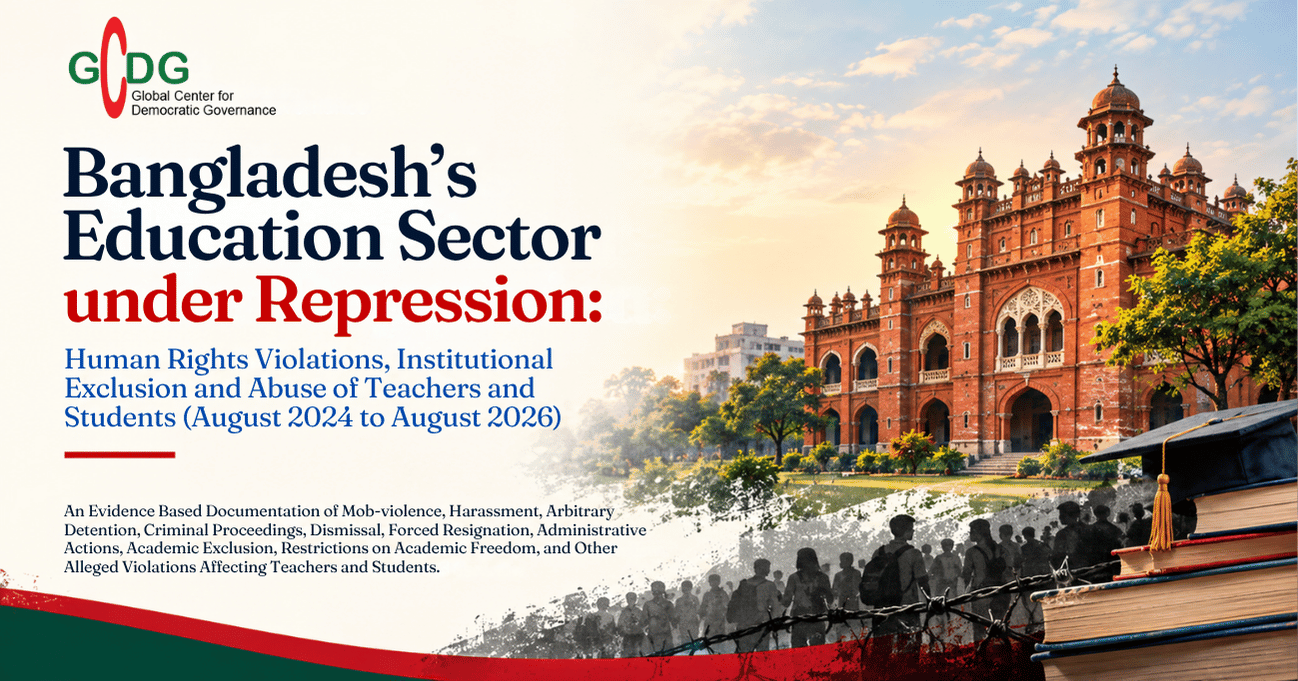
Bangladesh’s Education Sector under Repression: Human Rights Violations, Institutional Exclusion and Abuse of Teachers and Students
GCDG Research Publication
The Global Center for Democratic Governance (GCDG) has published a comprehensive study examining reported academic repression, institutional exclusion, disciplinary action, coercion, violence and related human-rights concerns affecting teachers and students across Bangladesh’s education system.
Titled Bangladesh’s Education Sector under Repression: Human Rights Violations, Institutional Exclusion, and Abuse of Teachers and Students, August 2024 to August 2026, the publication examines developments across schools, colleges, public and private universities, engineering institutions, medical and dental education, agricultural and veterinary education, technical and vocational institutions, and madrasas.
Published in September 2026, the study brings together documentary research, institutional and judicial records, structured datasets, media reporting, case studies and in-depth interviews to examine how adverse educational and employment measures have affected access to education, academic participation, professional life, freedom of expression, peaceful assembly and institutional due process.
Publication Details
Bangladesh’s Education Sector under Repression
Reporting Period: August 2024 – August 2026
Published: September 2026
Publisher: Global Center for Democratic Governance (GCDG)
A Cross-Sector Examination of Bangladesh’s Education System
The study examines whether teachers and students have been able to teach, study, participate in academic life, organise, express opinions and seek redress without violence, coercion, arbitrary exclusion, discriminatory punishment or other improper interference.
At the same time, the report stresses an important distinction between legitimate accountability and academic repression. It does not assume that every investigation, suspension, dismissal, arrest or disciplinary measure amounts to repression. Instead, individual cases are considered in relation to the evidence available, applicable procedures, proportionality, institutional authority and practical consequences.
The largest directly analysed student dataset contains 1,088 non-empty response records. Of these, 381 records — approximately 35.0% — reported informal exclusion from academic activities. Other recorded categories included suspension, show-cause notices, expulsion, forced institutional change, certificate cancellation and exclusion from residential halls.
A separate school and college teacher register contains 188 raw entries: 112 reporting forced resignation, 17 reporting forced removal, and 59 concerning individuals reportedly unable to enter their institutions despite no formal resignation or removal.
Areas Examined in the Report
The publication examines reported incidents and institutional measures across primary and secondary education, colleges, general universities, engineering education, medical and dental institutions, agriculture and veterinary education, technical and vocational institutions, and madrasa education.
Its analysis considers issues including coerced resignation, academic exclusion, suspension and expulsion, restrictions on professional and student mobilisation, criminal proceedings, detention, violence and intimidation, institutional due process, academic freedom, access to education, and safeguarding concerns involving children.
Accountability, Due Process and Effective Remedy
A central theme of the study is that accountability for proven misconduct and protection of human rights should not be treated as competing objectives. The report examines whether adverse measures were supported by individual evidence, imposed by competent authorities, accompanied by meaningful opportunities to respond, and proportionate to the conduct established.
Its recommendations address the review of student disciplinary and exclusion measures, protection of teachers from coercion, peaceful professional and student mobilisation, child safeguarding, effective remedies, preservation of evidence, institutional transparency and independent follow-up.
Full Publication
Read the Full Report
Access the complete publication, including its methodology, statistical analysis, case studies, recommendations, references and appendices.
DOWNLOAD FULL REPORTRelated Posts
Comments (0)