
GCDG Research Publication The Global Center for Democratic Governance (GCDG) has published an updated report…
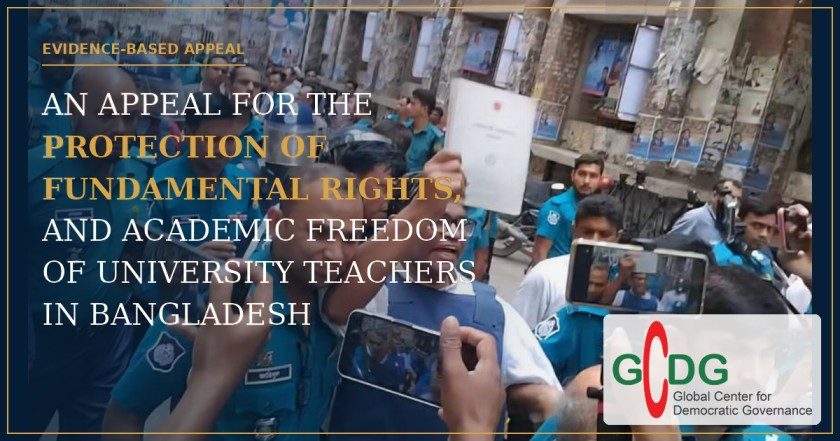
AN APPEAL FOR THE PROTECTION OF FUNDAMENTAL RIGHTS, AND ACADEMIC FREEDOM OF UNIVERSITY TEACHERS IN BANGLADESH
Evidence-Based Human Rights Appeal
Protection of Fundamental Rights and Academic Freedom of University Teachers in Bangladesh
An evidence-based appeal to the international community and human-rights organizations concerning reported threats to academic freedom, due process, freedom of opinion and the fundamental rights of university teachers.
The Global Center for Democratic Governance (GCDG) presents an evidence-based appeal calling for independent scrutiny of reported intimidation, forced resignations, suspension, exclusion from academic activities, prolonged investigations, arrest and detention affecting university teachers in Bangladesh.
2024–26
Period examined by the evidence-based appeal
58
Dhaka University teachers reportedly remained barred from academic activities in April 2026
231
Dhaka University teachers reportedly listed for fact-finding concerning the July Uprising
404
Teachers across 22 public universities reportedly subject to investigations cited in August 2026 reporting
Overview of the Appeal
Since 5 August 2024, public-university teachers in Bangladesh have reportedly faced a range of adverse measures, including mob intimidation, demands for resignation, exclusion from campuses or academic activities, suspension, prolonged fact-finding proceedings, criminal cases and detention.
The appeal does not contend that every disciplinary or legal action taken against a teacher is unlawful. Universities and public authorities retain the responsibility to investigate genuine criminal or professional misconduct. The central concern arises where political opinion, political association or perceived affiliation may substitute for evidence, or where punishment or exclusion occurs without a meaningful and timely opportunity to respond.
Important Principle
Allegations are not equivalent to findings of misconduct. Individual cases
should be examined on their own evidence and with appropriate procedural
safeguards, impartial decision-making and access to effective review.
Key Areas of Concern
Mob Intimidation and Forced Resignation
The appeal documents reports of teachers and academic officials facing pressure, humiliation, threats or demands to resign following the August 2024 political transition.
Suspension and Academic Exclusion
Teachers have reportedly been suspended or prevented from teaching and participating in academic activities while investigations remained unresolved.
Fact-Finding and Procedural Concerns
Concerns include prolonged inquiries, limited time to respond, insufficient access to relevant material and uncertainty over the duration and outcome of administrative proceedings.
Political Opinion and Perceived Affiliation
The appeal raises concern where actual or perceived political views or lawful associations appear to influence institutional or disciplinary decisions.
Arrest and Detention
Reported arrests and periods of detention raise questions concerning political motivation, neutral application of criminal law, judicial review and fair-trial safeguards.
Impact Across Public Universities
Reported adverse measures extend beyond a single institution and include cases involving public universities in different regions of Bangladesh.
A Pattern Extending Beyond a Single University
The appeal reviews reported disciplinary and administrative actions at universities across Bangladesh. Measures described in the documented cases include suspension, dismissal, compulsory retirement, demotion, salary-scale reduction, cancellation of increments and exclusion from academic duties.
The underlying allegations differ from case to case and must therefore be assessed individually. Their broader significance lies in determining whether comparable standards of evidence, procedural fairness, proportionality and opportunity for defence have been consistently applied.
Constitutional and International Standards
The appeal places these reported developments within Bangladesh’s constitutional framework and relevant international human-rights standards. It highlights constitutional guarantees concerning equality before the law, protection of law, freedom of thought and conscience, and freedom of speech and expression.
It also refers to protections contained in the Dhaka University Order, 1973, including provisions concerning the freedom of university teachers and officers to hold political views and maintain lawful associations.
At the international level, the appeal refers to the International Covenant on Civil and Political Rights (ICCPR), the International Covenant on Economic, Social and Cultural Rights (ICESCR), the ILO Discrimination (Employment and Occupation) Convention, 1958 (No. 111), and the UNESCO Recommendation concerning the Status of Higher-Education Teaching Personnel.
“The central question is not whether university teachers should be accountable. It is whether accountability can be pursued while preserving equality before the law, academic freedom, freedom of opinion and expression, and meaningful procedural protection.”
Urgent Measures Requested
- Establish or support an independent and impartial review of reported cases involving intimidation, forced resignation, suspension, academic exclusion, arrest and detention of public-university teachers since 5 August 2024.
- Ensure that no teacher is suspended, dismissed or permanently deprived of academic responsibilities solely because of actual or perceived political affiliation, peaceful political opinion or lawful expression.
- Require disciplinary and fact-finding proceedings to provide clear notice, reasonable time to respond, access to relevant evidence, a genuine opportunity to be heard, impartial decision-making and reasoned decisions subject to effective review.
- Prevent student or political groups from determining teachers’ employment status through threats, coercion, physical intimidation or mob action.
- Independently review cases of arrest or detention where circumstances raise concerns about political motivation, arbitrary detention, excessive use of criminal law or denial of fair-trial safeguards.
- Review prolonged suspensions and exclusions to determine whether they have become punitive in substance in the absence of a final disciplinary finding.
- Provide effective remedies, including reinstatement where adverse action cannot be supported by established misconduct, together with appropriate remedies where due process or fundamental rights have been violated.
- Encourage relevant UN Special Procedures, OHCHR, UNESCO and academic-freedom organizations to monitor the situation and seek relevant information.
- Protect independent journalism and the ability of journalists and media organizations to document alleged abuses affecting educators.
- Include academic freedom, due process and protection against politically motivated retaliation in international human-rights engagement concerning Bangladesh.
Evidence and Methodology
The evidence assembled in the appeal is substantial but deliberately non-exhaustive. The reported circumstances have remained fluid, and some incidents may not have been reported publicly.
Where available, the cases presented are supported by media reporting, human-rights documentation, official university records, court documents and first-hand documentary evidence. The full appeal contains an extensive reference base and supplementary material for further examination.
Editorial note: This webpage provides a summary of the
evidence-based appeal. Individual allegations remain subject to verification,
independent assessment and applicable legal and procedural safeguards.
Readers should consult the full document for detailed cases, chronology,
references and supporting materials.
GCDG’s Final Appeal
Fundamental rights and academic freedom should not depend on which political group controls the state or holds influence on a university campus at any particular moment.
GCDG calls on international human-rights mechanisms, UNESCO, academic-freedom organizations and other concerned institutions to examine the reported treatment of university teachers and support independent, evidence-based scrutiny.
Legitimate accountability and academic freedom are not contradictory. Accountability must be grounded in reliable evidence, equal treatment, fair procedures and respect for fundamental rights.
Read the Full Appeal
Read the complete evidence-based appeal below, including the documented cases, timeline, legal framework, references and recommendations.
Read the Full Evidence-Based Appeal
Access the complete document for the detailed chronology, documented cases, constitutional and international legal framework, references and requested measures.
Read / Download Full Appeal Contact GCDGRelated Posts
Comments (0)