
Evidence-Based Human Rights Appeal Protection of Fundamental Rights and Academic Freedom of University Teachers in…
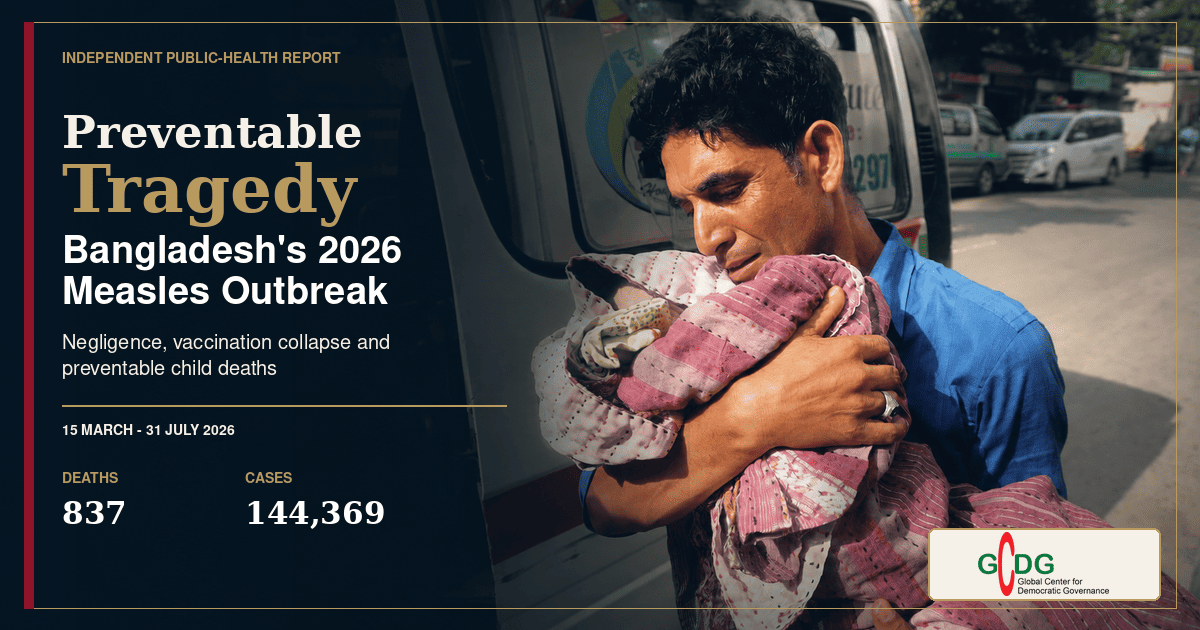
Preventable Tragedy: Bangladesh’s 2026 Measles Outbreak
Preventable Tragedy: Bangladesh’s 2026 Measles Outbreak
Negligence, vaccination collapse, health-system failures, and preventable child deaths.
144,369
Reported Cases
837
Reported Deaths
110,987
Hospital Admissions
56.2%
2025 Vaccine Coverage
The 2026 measles outbreak in Bangladesh represents a major public-health emergency involving widespread transmission, declining vaccination coverage, severe pressure on hospitals, and hundreds of reported deaths.
Overview of the Report
The Global Center for Democratic Governance has published an extensive report examining the causes, progression, and consequences of Bangladesh’s 2026 measles outbreak.
The report reviews disruptions to routine immunization, vaccine procurement delays, administrative and institutional failures, hospital preparedness, emergency response measures, legal accountability, and public demands for justice.
Central finding
The report argues that the outbreak was not simply an
unavoidable health emergency.
It links the crisis to a combination of falling vaccination
coverage, vaccine shortages, interruptions to essential health
programs, delayed public-health action, and weaknesses in the
medical system.
Outbreak at a Glance
| Indicator | Reported Figure |
|---|---|
| Suspected measles cases | 128,310 |
| Laboratory-confirmed cases | 16,059 |
| Total reported cases | 144,369 |
| Patients admitted to hospital | 110,987 |
| Patients discharged | 106,859 |
| Suspected measles deaths | 741 |
| Laboratory-confirmed deaths | 96 |
| Total reported deaths | 837 |
How the Crisis Developed
Although the outbreak appeared sudden to much of the public, the report describes a growing immunity gap that developed following disruptions to routine vaccination and vaccine supply during 2024 and 2025.
Measles is highly contagious and can spread rapidly when a large number of children remain unvaccinated or receive only one dose. Once cases began increasing, the infection spread across the country and placed substantial pressure on hospitals and health workers.
Major Factors Identified
1
Falling vaccination coverage
Reported measles vaccination coverage fell sharply, leaving a large number of children without sufficient protection.
2
Vaccine shortages
Procurement delays and stock shortages affected routine immunization services in different parts of the country.
3
Program disruption
Changes in health-sector programs reportedly interrupted vaccine transport, field activities, financing, and EPI sessions.
4
Missed catch-up campaign
A supplementary vaccination campaign that could have reached children missed by routine services was not implemented as originally planned.
5
Hospital capacity crisis
Hospitals faced shortages of isolation beds, pediatric intensive-care capacity, trained staff, oxygen, and essential equipment.
6
Delayed preparedness
Surveillance, referral systems, treatment capacity, and targeted emergency interventions were reportedly insufficient during critical stages of the outbreak.
Collapse in Vaccination Coverage
The report states that measles vaccination coverage in Bangladesh declined to 56.2% in 2025, compared with levels above 90% in the preceding years.
| Year | Reported Measles Vaccination Coverage |
|---|---|
| 2021 | 99.7% |
| 2022 | 93.8% |
| 2023 | 97.3% |
| 2024 | 98.9% |
| 2025 | 56.2% |
The decline created a large population of unvaccinated or incompletely vaccinated children. The report identifies this immunity gap as a central condition that enabled rapid nationwide transmission.
Pressure on Hospitals
Healthcare facilities struggled to manage the number of patients. The report describes overcrowded wards, inadequate isolation facilities, shortages of beds and equipment, and limited pediatric intensive-care capacity.
In some hospitals, multiple children were reportedly treated in a single bed. Families also faced difficulties finding facilities capable of admitting and treating critically ill children.
“A vaccine-preventable disease became a nationwide humanitarian crisis amid interruptions to immunization, weak preparedness, and major health-system constraints.”
Summary of the central argument presented in the reportGovernment Response and Accountability
The report evaluates the response of both the interim administration and the government formed in February 2026. It examines whether warnings were acted upon, whether vaccination and procurement decisions were timely, and whether hospitals received adequate preparation and support.
It also documents court petitions, demands for investigations, public demonstrations, and calls for compensation for families affected by preventable deaths and injuries.
Recommendations and Call for Action
The report calls for an independent investigation to establish the facts and determine responsibility through an impartial process. It also urges national and international institutions to assist Bangladesh in controlling the outbreak and rebuilding its immunization system.
Its broader recommendations emphasize uninterrupted vaccine supply, strong routine immunization, transparent public-health governance, rapid disease surveillance, effective referral and isolation systems, pediatric critical-care capacity, and institutional accountability.
Public-health lessonEssential vaccination services must remain operational during
administrative or political transitions. Interruptions in vaccine
procurement, delivery, surveillance, and emergency preparedness
can place millions of children at risk.
Read the Full Report
Download the complete independent public-health report for detailed data, analysis, references, timelines, and recommendations.
Download Full Report
Report:
Preventable Tragedy: Bangladesh’s 2026 Measles Outbreak —
Negligence, Vaccination Collapse, Health-System Failures,
and Preventable Child Deaths
Publisher: Global Center for Democratic Governance (GCDG)
Publication date: August 6, 2026
Publisher: Global Center for Democratic Governance (GCDG)
Publication date: August 6, 2026
Related Posts

Comments (0)